


How to Learn a Foreign Language: 20 Firsthand Tips
Have you ever tried to learn a new foreign language with excitement, but stopped after a few weeks?
It happens more often than you can imagine. Many people lose their motivation because they try to achieve too much too soon or they don’t have a clear roadmap to follow.
The good news for you is that learning a foreign language doesn’t have to be difficult. With a simple approach and the right roadmap, you can make steady progress.
Our experts designed these 20 practical tips to help you learn a new language like a native speaker with confidence, motivation, and improved skills step by step
Key Takeaways
- Create a clear learning plan and stay consistent. Set realistic goals, follow a simple study schedule, and practice for 20–30 minutes every day instead of cramming.
- Learn the language the way you’ll use it. Focus on common words, useful phrases, regular listening, and speaking practice to build real-life communication skills.
- Keep practicing and don’t fear mistakes. Review what you’ve learned, track your progress, and treat every mistake as a step toward becoming a confident and fluent speaker.
Start With a Clear and Realistic Plan
Many new learners start with excitement but then lose motivation after a few weeks. The reason behind this is not having a clear and realistic direction.
Your plan does not need to be very complex! But it should be simple. Simple and clear helps you know what to study, how often you need to practice, and what success really looks like.
To stay consistent, focus on one step at a time instead of learning everything at once. A realistic yet practical plan reduces stress and keeps you from feeling overwhelmed when you start learning a foreign language.

1. Choose a Language You Truly Want to Learn
Your personal interest in learning a new foreign language plays a vital role in staying motivated. When you enjoy the language and find the purpose, studying feels less like a task and more like fun and an exciting journey.
Ask your self question like:
- Will this language help my career or education?
- Do I enjoy listening to its music or watching its movies?
- Does its culture interest me ?
Try to make an emotional connection with the language you are learning as it aids your journey.
2. Decide Why the Language Matters to You
When you feel exhausted or overwhelmed, your reason for learning a language will become your highest motivation.
“Just like I am a traveler , my highest motivation is to learn the language for everyday conversation. But if I am visiting the country for business or professional purposes then my focus shifts to business communication. In both scenarios the purpose is different”
| Learning Goals | What to Focus On while learning |
|---|---|
| Traveling | Your Speaking, listening, everyday phrases |
| Career opportunity | Learning Professional vocabulary, writing, presentations |
| Studying Abroad | Focus on Grammar, academic reading, writing |
| Personal Interest | Focus on everyday conversations, books, movies, culture |
3. Set Small and Measurable Goals
Don’t set goals that are vague or too broad, as this is the biggest mistake new learners make!
❌ Instead of just saying:
“I want to become fluent speaker this year.”
✅ Break this into smaller milestones:
- Let’s learn 15 new words by the end of this week
- I will practice speaking for 20 minutes daily.
- I will watch one short video without subtitles.
These small achievements will build confidence in you.
4. Build a Simple Weekly Study Schedule
If you want to beat intensity then consistency is the key!
Many learners study for more than 1 hour daily and then feel exhausted. It’s better to study and learn a foreign language for a shorter period of time daily so you feel more focused and fresh.
A flexible routine is easier to follow than a strict time table. If you accidentally miss one day, then simply continue the next day instead of just giving up.
Create Strong Language-Learning Habits
Your motivation can come and go, but your habits help you keep moving forward.
To become a successful language learner, don’t rely on feeling inspired everyday. You’ve to create a routine that becomes a part of your daily life. Over time, your small learning habits lead you to big improvements in:
- Vocabulary
- Grammar
- Listening
- Speaking
5. Study for a Short Time Every Day
You really don’t need long hectic sessions for learning a foreign language.
The best way to learn a foreign language is to follow regular, shorter sessions that help you retain information.
Try to learn a new foreign language for about 20 to 30 minutes a day. During this time, focus on one skill only instead of trying to learn everything at once.
Assign a day for specific language skill learning just like:
- Monday: Vocabulary
- Tuesday: Grammar
- Wednesday: Listening
- Thursday: Speaking
- Friday: Reading
This approach helps you keep your mind fresh.
6. Review Old Lessons Before Starting New Ones
Learning new material is exciting, but to truly master a foreign language, it is important to review your previous lessons daily. This habit helps you retain what you’ve learned.
Spend your first 5 to 10minutes of daily sessions revising the vocabulary, grammar rules, or conversation phrases you have learned already.
Simple review methods include:
- Reading yesterday’s notes.
- Testing yourself without looking at the answers..
- Writing five sentences with previously learned words.
7. Keep a Notebook for Useful Words and Phrases
Instead you write down random words, organise your notebook in a way that it helps you remember useful words and phrases naturally.
Try to group words on the basis of topics like:
- Food
- Travel
- Shopping
- Daily conversations
For each word write:
- The meaning of word
- A simple example sentence
- Pronunciation (if needed)
- A synonym or opposite word
This approach makes your revision faster and allows you to memorize isolated words.
8. Track Your Progress to Stay Motivated
If you don’t keep a record of your progress, you often believe you are not improving. To avoid this keep a simple record of what you are accomplishing every week.
Just like keep record of:
- New words you learned
- Grammar topics you’ve completed
- Minutes you spent speaking
- Books or articles you read
- Videos you watched
- Conversations you practiced
Learn Vocabulary in a Practical Way
Do you want to become a native speaker? Then learn a vocabulary the same way you’ll use it in real life. Focus on useful words, learn them in context, and review them regularly.
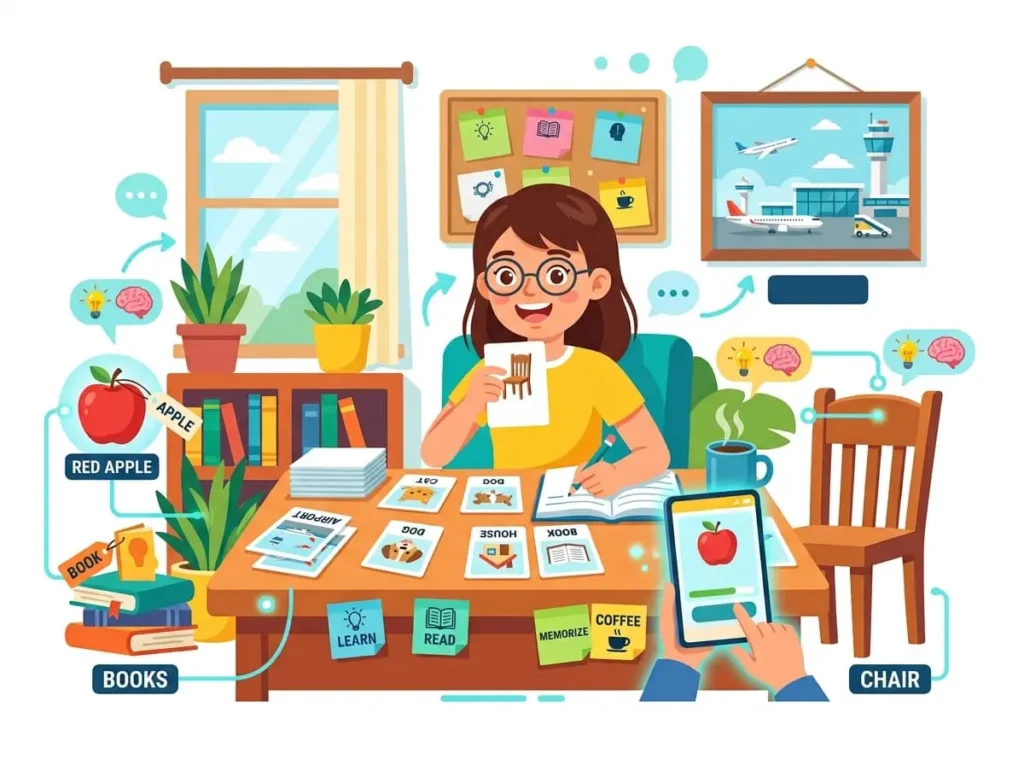
9. Focus on Common Words First
Not every word in learning a new vocabulary is important. Start with words you’ll hear and use in your daily life.
Following topics to learn new words will help you grow faster:
- Greetings
- Family and friends
- Food and drinks
- Shopping
10. Learn Complete Phrases Instead of Single Words
In real-life conversations, single words don’t stand alone. Everyone uses full phrases to communicate.
| Single Word | Better Phrase |
| ❌Sorry | ✅ I’m sorry I’m late. |
| ❌Coffee | ✅ Can I have a coffee, please? |
| ❌Understand | ✅ I understand what you mean. |
Learning full phrases will allow you:
- Natural sentence structure
- Correct grammar
- Better pronunciation
- Faster speaking
11. Use Flashcards with Spaced Repetition
To build your vocabulary, flashcards are one of the simplest tools. Especially when you are reviewing them at the right time.
You don’t have to look on every card everyday, spaced repetition shows you words just before you are most likely to forget them. This approach improves your long term memory and saves you time as well.
You can make flash cards using:
- Paper index cards
- A notebook
- Digital apps with spaced review
A good flash card must includes:
- The word or phrase
- Its meaning
- An example sentence
12. Connect New Words with Pictures and Experiences
Your brain remembers information when it has something meaningful to connect with. Just like:
- Learning the word “airport”? Think about your last trip.
- Learning the word “orange”? Picture a real orange or hold one while saying the word.
The stronger the connection with the word, the easier for you to recall it.
Improve Your Listening and Pronunciation
Many foreign language learners can read the language but struggle to understand the native speakers. That’s because every language has its own rhythm, speed and pronunciation.
Improving your listening skills does not require perfect understanding. The goal is to train your ears little by little until the sound becomes a familiar word..
13. Listen to Native Speakers Every Day
Listening to native speakers on a daily basis helps your brain to become familiar with the natural flow of language.
The good listening sources will include:
- Podcasts
- News clips
- YouTube videos
- Audiobooks etc.
It’s ok if you don’t understand everything while listening. Doing listening practice for 10-15minutes daily will improve comprehension over time.
14. Repeat Short Audio Clips Out Loud
The fastest route to improve your pronunciation is to repeat what you hear immediately after a native speaker.
Choose a specific clip that’s only 10 to 20 seconds long
Then:
- Listen carefully.
- Pause.
- Repeat the same sentence.
This technique improves both your listening and speaking skills at the same time.
15. Copy the Speaker’s Rhythm and Tone
Saying words correctly is not enough for you, but to sound natural is more important to become a native speaker.
Notice how native speakers:
- Pause between ideas.
- Stress important words.
- Raise or lower their voice.
- Connect words together.
Just like you are copying the actor in the movie. Don’t only repeat the words they are speaking —but copy the way words are spoken.
16. Record Your Voice and Listen Back
While practicing, you don’t realise how you sound until you hear yourself.
So record your voice as it helps you in noticing:
- Mispronounced words
- Speaking speed
- Missing sounds
- Unnatural pauses
Practice Speaking with Confidence
Speaking is one of the most challenging parts of learning new language skills. It’s not because you don’t know enough about a language, but because you don’t feel confident and are afraid to make mistakes.
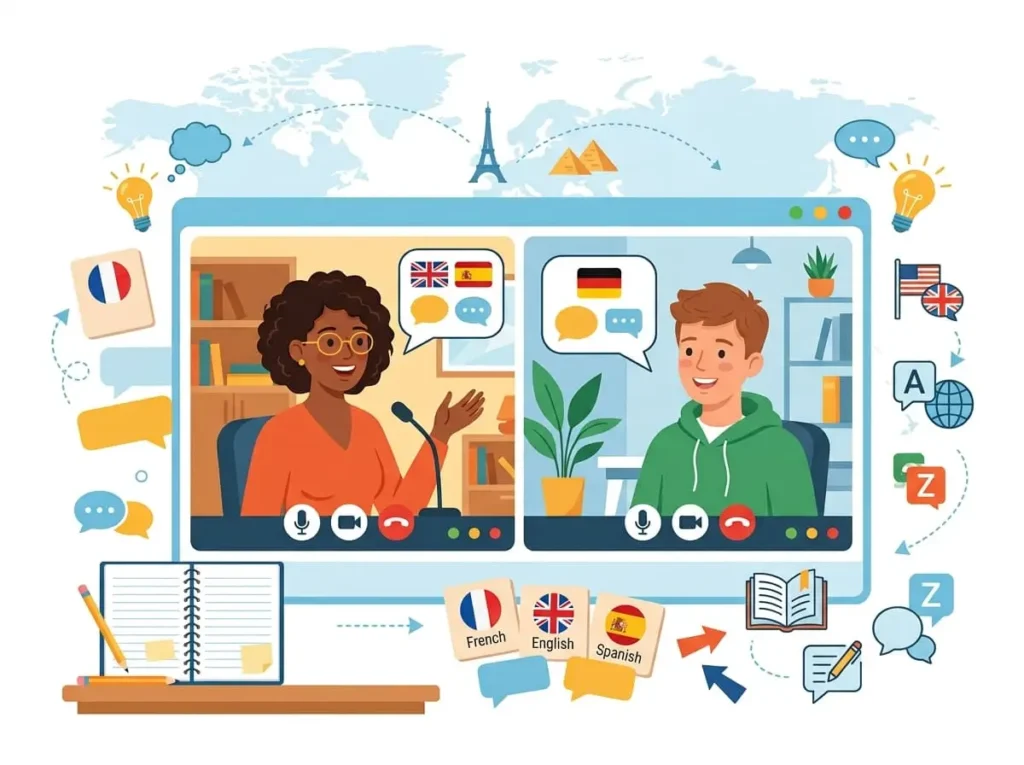
17. Start Speaking Before You Feel Ready
One of the biggest mistakes you make is that you try not to practice speaking a language until your grammar is perfect. In reality speaking is part of your learning process.
So try to start with simple sentences just like:
- “My name is…”
- “Can you help me?”
Every conversation allows you to learn something new, and it helps you to become fluent.
18. Find a Language Partner or Tutor
Learning a foreign language alone will restrict you in multiple ways. So you need an experienced learning tutor that can:
- Correct your mistakes gently.
- Improve your pronunciation.
- Introduce you with natural expressions.
- Build your confidence.
- Keep you motivated.
At Art of Language, our tutors help you improve much faster by combining speaking practice with regular feedback, instead of studying alone.
19. Use the Language During Daily Activities
Your practice doesn’t have to stop when your language lesson ends.
- Do language practice while:
- Making a shopping list.
- Thinking about your day.
- Writing short notes.
The more you practice the language in your daily life, the more natural it becomes.
20. Treat Mistakes as Part of Learning
Your mistakes are not a sign of your failure. It’s proof that you are practicing.
Every correction while learning a language helps you improve and grow.
Instead of worrying about speaking perfectly:
- Focus on your communication.
- Ask questions when you’re unsure.
- Accept feedback positively.
- Learn from your repeated mistakes.
How to Keep Improving Over Time?
Learning a foreign language doesn’t end after completing a course or reaching a certain level. The learners who continue improving are the ones who keep using the language in different ways.
Here are a few learning habits that make long-term progress easier for you.
Mix Reading, Writing, Listening, and Speaking
While learning a new language each skill supports the others to help you become a native speaker.
A mix and balanced routine while learning a new language looks like this:
| Skill | Daily Activity |
| Reading | Read a short article or story |
| Writing | Write five simple sentences |
| Listening | Listen to a podcast or video |
| Speaking | Practice with a tutor or friend |
By using all four skills, you can become a well-rounded language learner instead of being strong in only one area.
Make the Language Part of Your Daily Life
Learning a new language becomes easier when the language is around you every day.
Here are some simple ideas for you:
- Following social media accounts in your target language.
- Watching videos with subtitles.
- Listening to music during your commute.
- Reading children’s books or short articles.
Change Your Study Method When Progress Slows
At some point in your learning journey, you will feel your progress slow down. But don’t worry—this is completely normal.
Instead of studying for a longer period of time, try to study the language differently. Just like:
- Switch from practicing grammar exercises to conversations.
- Replace vocabulary lists with short stories.
- Watch videos instead of just reading.
Celebrate Small Wins Along the Way
Don’t wait until you’re fluent in a language to feel proud.
Celebrate your small wins like:
- Having your first conversation.
- Understanding a movie scene.
- Learning 100 new words.
These small wins remind you that progress is happening, even if it feels very slow.
Final Thoughts
To become a native speaker in foreign language don’t try to find shortcuts. But build the right habits and stay consistent in practicing the language. Just don’t give up!
At Art of Language, we believe every learner can become a confident speaker with the right guidance, regular practice, and a supportive learning environment. No matter from where you’re starting, each conversation, each new word, and each small success brings you one step closer to becoming a fluent speaker.
Frequently Asked Questions
How long does it take to become fluent in a foreign language?
It highly depends on the language, your learning approach, and how often you practice a foreign language. Many learners see steady progress within a few months with a consistent study routine. But to become fluent in language you might take a year with consistent practice.
Can adults learn a new language successfully?
Yes of course! Adults can become confident language speakers. While the children may learn the pronunciation of words more naturally. On the other hand, adults often have stronger study habits and learning strategies that help them progress effectively.
Is it possible to learn a language without living abroad?
Absolutely Yes! You can start your learning journey from home by taking online classes, practicing with native speakers, watching videos, and practicing a language everyday. . Consistent practice matters more than your location.
Should I learn grammar or vocabulary first?
You can learn grammar and vocabulary together. Start with useful vocabulary words and simple phrases, then learn the grammar that helps you use them correctly. This approach feels more natural and improves communication faster.
How many new words should I learn each day?
As a beginner learning 5 to 10 new words or phrases a day is the most recommended and realistic goal. However, review them regularly using spaced repetition so they move into your long-term memory instead of being forgotten after a few days.
Can I study two foreign languages at the same time?
Yes obviously you can! But to master one language at a time is easier for you. But still if you choose to study two languages , give each language its own study time and avoid learning very similar languages together as a beginner.
What should I do when I understand a language but cannot speak it?
In this case you can try practicing a language by speaking everyday for 10-15 minutes through various means like, trying to read books or text aloud to improve the fluency and pronunciation, listen to the audios in that particular language and try speaking by repeating them immediately.
How can I avoid forgetting a language after learning it?
After learning a language try being consistent in improving and polishing language. Reading books, articles or news etc in that language. Watching TV shows, movies, YouTube videos etc. in the particular language. Speaking with native speakers and also by writing short journals helps to prevent forgetting a language.