

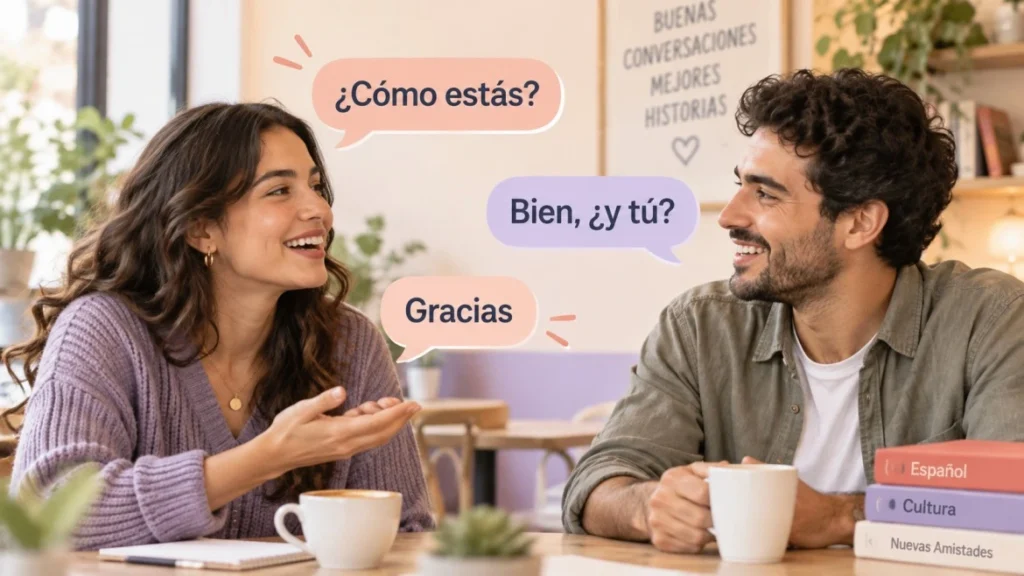
How to Reply in Spanish Like a Native_ 2026 Guide
It is easy to memorize that ¿Cómo estás? means “how are you?” and gracias means “thank you.” But the moment someone actually speaks to you in Spanish? Everything you know suddenly flies out of your head, and you’re just standing there like a deer in headlights.
That’s why learning natural replies matters, not just memorizing textbook responses that nobody uses in real life. Hence, learn what people say when they’re just talking. The short answers. The little follow-up questions. The reactions that keep the conversation flowing instead of killing it.
This guide walks you through how to reply in Spanish for the situations that come up all the time. Greetings. Thank-yous. Introductions. Small talk. We’ll also talk about tone and formality, because the way you reply to your friend is not the same as how you reply to your boss or a stranger.
Key Takeaways
- Short replies sound more natural than long, perfectly constructed sentences.
- When someone asks ¿Cómo estás?, give a real answer and usually ask ¿Y tú? back.
- De nada works for “you’re welcome”, but a simple “no hay problema” or “por nada” fits better.
- Don’t translate every English phrase word for word, as Spanish has its own rhythm and flow.
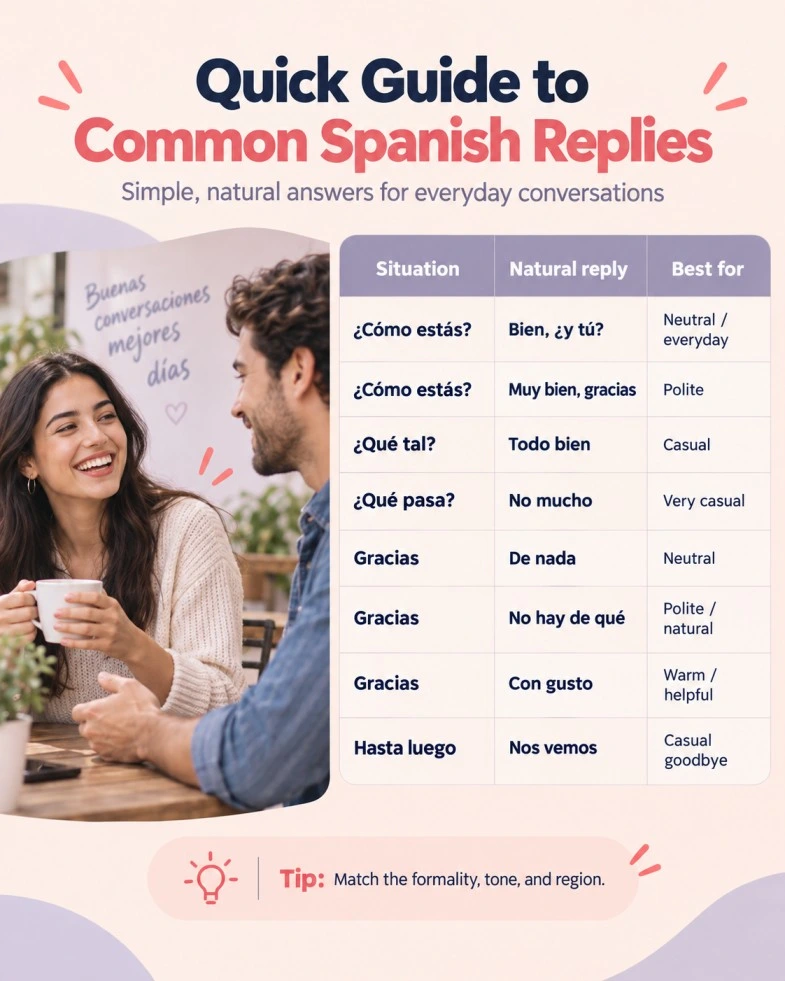
Quick Guide to Common Spanish
Here’s a quick cheat sheet you can flip back to whenever you need a natural reply. The detailed breakdown below gives you the full picture.
| What you hear | Natural reply | Meaning | Use |
| Hola | Hola / Buenas / ¿Qué tal? | Hello / Hi / How’s it going? | Neutral and widely understood |
| Buenos días | Buenos días | Good morning | Polite and common |
| Buenas tardes | Buenas tardes | Good afternoon | Neutral and polite |
| Buenas noches | Buenas noches | Good evening / Good night | Greeting or goodbye |
| ¿Cómo estás? | Bien, ¿y tú? / Todo bien | Good, and you? / All good | Use ¿y usted? in formal situations |
| ¿Qué pasa? | Nada / Todo bien | What’s up? / Nothing / All good | Casual |
| ¿De dónde eres? | Soy de.., ¿y tú? | I’m from.., and you? | Simple answer plus a return question |
| Gracias | De nada / Con gusto / No hay de qué | You’re welcome / My pleasure | Choice varies by tone and region |
| Muchas gracias | De nada / Con gusto | Thank you very much / You’re welcome | Polite and friendly |
| Buen trabajo | Gracias / ¡Muchas gracias! | Good job / Thanks | Natural response to praise |
| Mucho gusto | Igualmente / Mucho gusto | Nice to meet you / Likewise | When meeting someone |
| Nos vemos | Nos vemos / Hasta luego | See you / See you later | Casual goodbye |
| Que tengas un buen día | Igualmente / Gracias, igualmente | Have a good day / Same to you | Friendly and polite |
How to Respond to “¿Cómo Estás?” Like a Native
Walk into a store. Meet a friend. Run into a neighbor. But don’t know how to respond to cómo estás like a native? Don’t worry. Even your answer doesn’t need to be complicated. You’re not giving a speech. You’re just responding to a greeting.
Neutral and Positive Replies
If you’re doing fine, keep it real simple. Here are the go-to options:
- Bien, ¿y tú? – Good, and you?
- Muy bien, ¿y tú? – Very good, and you?
- Todo bien – Everything’s good
- Todo bien, gracias – All good, thanks
- Bastante bien – Pretty good
- Muy bien, gracias. ¿Y tú? – Very good, thanks. And you?
Bien, ¿y tú? is probably the safest, most everyday answer you can give. If you’re talking to someone formally, just switch tú to usted: Bien, ¿y usted? Simple as that. The thing is, nobody expects you to write a paragraph about your day. A short, natural reply is all you need.
Honest Replies When You’re Not Great
Spanish gives you plenty of ways to be honest without getting too deep-
- Más o menos – So-so
- Ahí vamos – Getting by, hanging in there
- No muy bien – Not very well
- He tenido días mejores – I’ve had better days
- Estoy un poco cansado/a – I’m a little tired
“¿Cómo estás?” is often just a social greeting. It’s not always an invitation to unload everything that’s going on in your life. A short answer, followed by ¿y tú? or ¿y usted? is more than enough.
How to Reply to Other Common Spanish Greetings
Spanish conversations have lots of other little greetings. Some are questions, some aren’t, and some are so casual. Let’s have a look at some of these words.
Replies to “Hola,” “Buenas,” and “¿Qué Tal?”
Someone walks up to you and says Hola. You say Hola back. That’s it. Spanish speakers aren’t looking for creativity here. So don’t overthink it and move on. If you want, you can toss a ¿Qué tal? But a plain Hola is fine on its own.
Now, “Buenas” you’ll hear it everywhere. They chop off the end and leave it at Buenas. And when someone says it to you? Just say Buenas back. Easy. Don’t try to respond with the full version, as you’ll sound stiff. Keep it short.
Then we’ve got ¿Qué tal? This one’s interesting because it’s a real question-like, ” How are you doing? Other times it’s just a way of saying “what’s up?” So what do you actually say back? Here are some go-to responses you can use-
- Muy bien – this is your default. Works every time.
- Todo bien – means “all good.” Super common.
- Bien, ¿y tú? – This one’s polite because you’re handing the question back to them.
- Todo tranquilo – this is more laid-back. Like “everything’s chill.”
How to Reply to “¿De Dónde Eres?”
This one’s not complicated. They ask where you’re from. You tell them. Then you ask the same thing back. Soy de México. ¿Y tú? That little ¿y tú? is what keeps it from feeling like a dead end.
If you grew up somewhere but live somewhere else now, you can say both: Soy de Colombia, pero vivo en Estados Unidos. ¿Y tú? That way, they know your background and your current situation in one go. It’s clean and covers what they’re probably curious about anyway. So keep it short.
Replies to Introductions and Goodbyes
If someone introduces themselves, you say “Mucho gusto.” That’s the move. Works for everything, including job interviews, house parties, meeting your girlfriend’s parents, whatever. Say someone’s like Hola, soy Ana. You just go Mucho gusto, Ana. Including their name makes it feel less robotic, like you’re actually paying attention.
Now goodbyes. Adiós is fine, but it feels kind of heavy. Like you’re leaving town or something. Most people I know don’t really use it that much in everyday stuff. What you hear way more is Nos vemos. Super casual, just “see you.” Or Hasta luego, which is everywhere. You can’t go wrong with that one. Hasta pronto if you know you’re gonna see them again soon.
How to Speak Spanish More Like a Native
Don’t just memorize words from a list. Pay attention to how people actually talk. The little fillers they throw in, the quick reactions. If you’re wondering how to speak like a native in Spanish, start by noticing these everyday chunks. Questions that keep the other person talking. That’s what makes it flow.
Use Short Reactions and Follow-Up Questions
Say someone tells you, “Conseguí trabajo. – I got a job. If you just say bien, that’s fine. You said something. But it kind of stops there. You want to sound more natural? Throw in a reaction and a question, ¡Qué bien! ¿Dónde? – That’s great! Where?
Now they’ve got something to respond to. The conversation keeps moving instead of just dying out. Here’s some stuff people actually say-
- ¡Qué bien! – That’s great!
- ¡Qué bueno! – That’s great!
- Claro – Of course.
- Exacto – Exactly.
- Ya veo – I see.
- ¿En serio? – Really?
Pick two or three and start using them. They’ll just come out naturally. That’s when you know it’s working.
Use Fillers Without Overusing Them
Spanish speakers throw in little filler words all the time. It’s not because they don’t know what to say; it’s just how people talk. Stuff you can use-
- Bueno -Well
- Pues – Well
- A ver – Let’s see
- O sea – I mean
- Entonces – So
Tossing these in now and then makes you sound less stiff. Like you’re not reading from a script or trying to spit out perfect sentences every single time. Best way to figure out the sweet spot for fillers? Just listen. Pay attention to how native speakers actually use them. Or check out Spanish classes at the Art of Language Institute to speak like a native with confidence.
Match Formality, Tone, and Region
This one actually matters more than people think. The way you talk to your buddy over beers shouldn’t be the same way you talk to your boss or a customer. That’s where the whole tú versus usted thing comes in. Tú is casual, usted is more formal. The line gets drawn differently depending on where you are. In some places, people use usted all the time. In others, hardly ever. You gotta feel it out.
Same deal with slang. What sounds totally normal in Mexico might get you weird looks in Argentina or Spain. Or worse, as it might mean something completely different. Even significant differences in vocabulary among regional dialects of Spanish. So, instead of asking, “Is this word correct?” Ask something more useful. Like “Who actually says this? Or what situation do they use it in?” That’ll get you a lot further in the native race.
How to Respond to “Gracias” Like a Native
If you’re wondering how to respond to gracias like a native, the good news is that you have more options than just de nada. De nada is perfectly fine, but native conversations don’t always use the same response.
- De nada – You’re welcome. Safe and widely understood.
- Con gusto – My pleasure / Gladly
- No hay de que – Don’t mention it
- Claro – Sure / Of course
- Cuando quieras – Anytime
- A ti – Thank you / Thanks to you
Native speakers use different responses for different moments. Sometimes it’s de nada. Sometimes it’s something else. Pay attention and pick up a couple of alternatives. That’s how you stop sounding like a textbook.
How to Say Thank You in Spanish Like a Native
Gracias is your bread and butter. Use it all day long, and nobody’s gonna think twice. No need to get creative every time.
Everyday Ways to Show Thanks
For most situations, these will get you through just fine-
- Gracias – Thank you
- Muchas gracias – Thank you very much
- Mil gracias – Thanks a million
- Gracias por todo -Thanks for everything
- Te lo agradezco – I appreciate it
Mil gracias is great when you want to sound warm but not too formal. If you really mean it, ¡Mil gracias! Me ayudaste muchísimo. It means Thanks a million! You helped me so much.
Thanking Someone for a Specific Action
If somebody actually did something for you, saying what you’re thanking them for sounds way warmer than just throwing out a plain gracias. Try these-
- Gracias por venir -Thanks for coming
- Gracias por tu ayuda – Thanks for your help
- Gracias por esperarme – Thanks for waiting for me
- Gracias por avisarme – Thanks for letting me know.
Further, throw in a “mucho” if you want to crank up the appreciation. Te lo agradezco mucho. If you’re in a formal situation, just switch the pronoun.
Don’t just memorize a bunch of thank-you phrases and call it a day. Learn a few that let you thank people for specific stuff. That’s what gives your Spanish some range. Makes you sound like an actual person instead of someone who learned from a script.
How Do Mexicans Say “Very Good”?
There’s no single magic word for “very good.” Muy bien, works fine. Everybody understands it. But Mexican Spanish has a bunch of casual ways to say it. Here’s what you’ll hear-
- Muy bien – Very good
- Muy bueno- Very good or really good
- Qué bueno- That’s great
- ¡Qué padre! – That’s cool / That’s great
- Está muy bien – It’s very good
- Excelente – Excellent
- Súper bien – Really good.
Even you might just say, ¡Qué bueno! Or ¡Super bien! If you’re talking about food, a movie, or something you experienced, “está muy bueno” means it’s really good. Then, there’s que padre. That one’s pretty Mexican. Means “that’s cool” or “that’s great” depending on the situation. It’s casual, it’s friendly, and it’s everywhere.
Common Mistakes That Make Replies Sound Unnatural
People learning Spanish worry about messing up grammar. Most awkward replies don’t come from bad grammar. They come from translating English word-for-word and calling it a day. Here are a few things to watch out for-
- Don’t overthink simple greetings. A short answer is usually plenty.
- Don’t throw slang everywhere just because you learned it. Regional expressions have their place.
- Don’t assume tú works with everyone. Read the room and the person you are talking to.
- Don’t translate idioms as a phrase that sounds natural in English may sound strange in Spanish.
- Don’t just memorize replies without hearing them first. The rhythm matters.
Further, people try to sound “native” way too fast. They collect slang like trading cards because they think that’s what makes you sound authentic. The opposite usually works better. Get comfortable with everyday Spanish first. Build the foundation before you start decorating.
Final Thoughts
Start with the basics, as no need for a huge vocabulary or a list of complicated expressions. Learn a handful of reliable responses. Then, practice saying them out loud. Besides, pay attention to native speakers. When someone asks, ¿Cómo estás?, answer naturally. When they say gracias, don’t feel like you have to reach for something clever. When someone asks ¿De dónde eres?, answer and ask them back.
Those little exchanges are where conversational Spanish starts to feel real. Ready to take your Spanish beyond memorized phrases? Book a Spanish class at Art of Language Institute and practice speaking under the guidance of professionals.
Frequently Asked Questions
Is “Bien” Enough When Someone Asks How You Are in Spanish?
Yeah, bien works. Add ¿Y tú? If you want to keep it going. You can also use muy bien, bastante bien, más o menos, or todo bien. No need for a long response.
Should I Use “Tú” or “Usted” When Replying in Spanish?
Tú is the informal form used with friends and family. Use “usted” for older adults and people in authority to show respect.
Is “De Nada” Always the Best Reply to “Gracias”?
Not always. De nada is fine, but you’ve also got con gusto, no hay de qué, cuando quieras, claro. Pick what fits the moment.
Can I Use Spanish Slang With People From Any Country?
Careful. Slang changes a lot by country. What’s normal in Mexico might sound weird in Spain or mean something different elsewhere. Stick with neutral Spanish first, then pick up local expressions from the people you actually talk to.
How Can I Practice Natural Spanish Replies by Myself?
Practice small exchanges, and you’ll stop translating in your head. Make up little situations and answer out loud-
¿Cómo estás? – Bien, ¿y tú?
¿De dónde eres? – Soy de Canadá. ¿Y tú?
Why Do Native Spanish Speakers Sometimes Leave Words Out?
Spanish grammar allows pro-drop (omitting subject pronouns), and casual speech relies on relaxed pronunciation. Hence, context makes the missing pieces obvious without losing meaning.

