

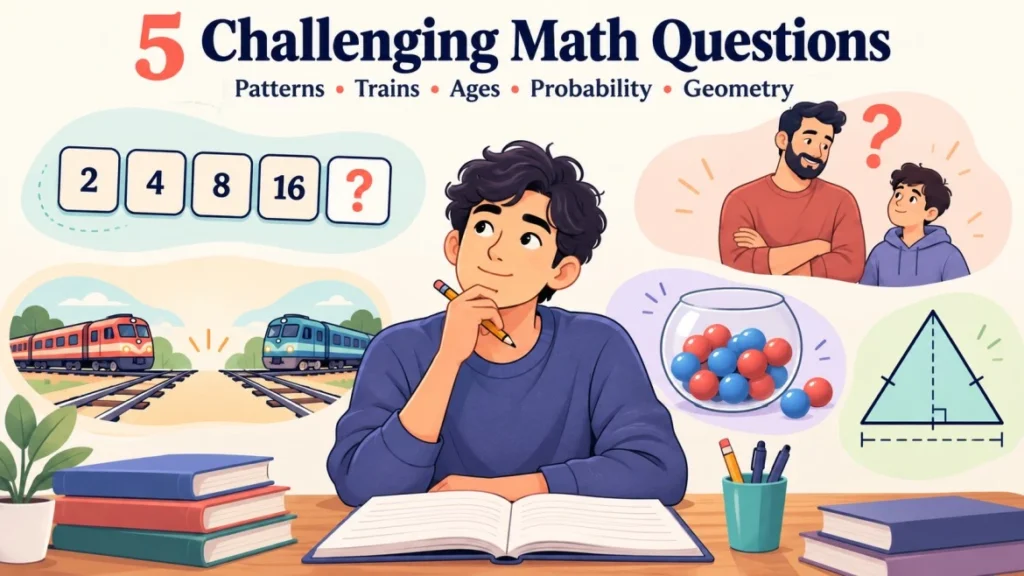
Top 5 Math Difficult Questions and Answers
Some math questions look difficult before you even start solving them. You see a long word problem or a geometry question and wonder which formula to use. But the hardest part isn’t the calculation. It’s figuring out where to start.
That’s what makes some math problems tricky. First, work out what the question is asking. Then, choose the right method. Next, take one step at a time. In this guide, we’ll look at the top 5 math difficult questions and answers covering patterns, speed, algebra, probability, and geometry. None of these mathematics questions requires an advanced formula. Just careful readings and logical thinkings.
Key Takeaways
- Hard math problems become easier if you break them into smaller steps
- Look for usual patterns before reaching for a final formula
- Write an equation when the problem involves unknown values
- In probability questions, separate favorable outcomes from total outcomes.
Why Do Some Math Questions Feel Difficult?
Math questions can trip you up for all kinds of reasons. Sometimes there’s just too much going on, like multiple numbers or too many steps. Sometimes the wording twists something simple. Sometimes you even know the formulas, but not which one fits.
The first move? Slow down. Read the question and pull out two things. What info do I actually have, and what am I supposed to find? For example, take a train problem. It gives you two speeds and the distance between them. You don’t touch the numbers yet. You just need to see that both trains are heading toward each other. That changes everything.
The same goes for algebra, probability, and geometry. Write it down. Figure out the relationship. Then do the math. That one habit makes even the hardest questions way more manageable.
1. Can You Find the Next Number in This Pattern?
What number comes next? 2, 6, 12, 20, 30,_?
No obvious rule. So don’t guess. Just look at the gaps between each number.
6 – 2 = 4
12 – 6 = 6
20 – 12 = 8
30 – 20 = 10
Now you see it. The differences are 4, 6, 8, 10. Each one goes up by 2. So the next difference should be 12. Hence, add it to the last number: 30 + 12 = 42. So, the answer is 42.
This is a classic example of how pattern questions trick you. You might look for a complex formula when the real clue is just sitting there in the gaps. A steady increase or decrease is often the pattern to find the next number.
2. When Will Two Trains Meet?
Start with an easy question. Two trains are 160 km apart. One goes 60 km/h, the other goes 20 km/h. They start at the same time and head toward each other. How long until they meet?
They’re moving toward the same point. So the trains’ speeds are working together, not against each other. Hence, 60 + 20 = 80 km/h.
That’s how fast the gap between them is closing. Now, you have to figure out how long it takes to close 160 km at that speed. So, the answer is 160 ÷ 80 = 2 hours.
Let’s check the answer. In 2 hours, the first train covers 120 km. The second covers 40 km. Add them up, 120 + 40 = 160 km. Exactly what we started with.
People make this harder than it needs to be. They think they have to solve for each train separately. But you don’t. They’re moving toward each other, so you just combine the speeds and go from there.

3. How Old Are the Father and Son?
Suppose a father is three times as old as his son. Together, their ages add up to 48. How old are they?
Let the son’s age be x. The father is three times older, so that’s 3x. Together, they add up to 48.
Hence, x + 3x = 48. If we combine them, we get 4x = 48. Divide both sides by 4, and we will get x = 12. So, the son is 12. The father is 3 * 12 = 36.
Always check your work on age problems. Does 36 equal three times 12? Do they add up to 48? 36 + 12 = 48.
If your answer doesn’t fit back into the question, something’s off. Go back and check your equation. Get that variable right, and the rest of the problem works itself out.
4. What Is the Probability of Not Choosing a Blue Ball?
If a bag has 10 balls in it, with 3 blue, 4 red, and 3 green. You pick one without looking. What’s the chance it’s not blue?
First, figure out the total. 3 + 4 + 3 = 10 balls. Now, what does “not blue” mean? That means red or green. So, 4 + 3 = 7 balls. Out of 10 total, 7 are not blue. So the probability is 7/10.
As a percentage, that’s 70%. Hence, the answer is 7/10 or 70%.
You could also flip the hard mathematics questions and answers. The chance of picking blue is 3/10. So the chance of not picking blue is 1 minus that 7/10; same result. The whole thing comes down to catching that one word: not. Miss it, and you’ll solve the wrong problem. Catch it, and it’s simple.
5. Can You Calculate the Area of This Triangle?
Let’s continue with a simple question. If a triangle has a base of 14 cm and a height of 9 cm, what is its area?
For the area of a triangle, use: Area = 1/2 × base × height
Now put in the numbers: Area = 1/2 × 14 × 9
Half of 14 is 7. Then, 7 × 9 = 63. So, the answer is 63 cm2.
This one may seem much easier. But geometry questions cause mistakes if you use the wrong measurement. Remember that the height must be the perpendicular distance from the base to the opposite point. It isn’t necessarily the length of one of the triangle’s sloping sides.
Quick Comparison of the Five Math Problems
| Problem | Main Skill | Method | Answer | Tips |
| Number pattern | Pattern recognition | Check the growing differences | 42 | Don’t guess; compare the gaps |
| Two trains | Speed, distance, and time | Add speeds, then divide the distance | 2 hours; 160 km | Pay attention to their direction |
| Father and son | Basic algebra | Create and solve an age equation | 36 and 12 | Define the unknown first |
| Colored balls | Probability | Favorable outcomes ÷ total outcomes | 7/10 or 70% | Watch for words like “not” |
| Triangle area | Geometry | ½ × base × height | 63 cm² | Check which side is the height |
How to Solve Difficult Math Questions Step by Step?
A math problem can look like a total mess. Just stop for a second and ask what they are even asking? Then, separate known and unknown variables. For word problems, write the numbers down. Just seeing them on paper makes everything clearer.
Then, ask yourself what connects what you know to what you’re looking for. A pattern or something else. Find that link. Take it slow. Don’t zip past steps just because they look easy. That’s where people mess up.
Once you’ve got a number, check it. Does it actually make sense? Are the units right? Try to put it back into the original question so it works. That’s really it. For mastering complex ones, book a mathematics lesson to increase your understanding and confidence.
Common Mistakes to Avoid
- Never ignore the wording. Words like total, difference, remaining, toward each other, and probability change how you approach the problem. Miss them, and you’ll likely get it wrong.
- Using the wrong formula. Make sure it actually fits the information you have. Not every formula works for every problem.
- Always check your answer. A quick second look catches many simple mistakes. It’s worth the extra few seconds.
- Don’t take everything in your head. Write down your steps. That’s how you spot where things went off track.
- Long problems don’t need a fancy answer. Sometimes a question that looks complicated just needs basic arithmetic. Once you see the relationship, it’s often simpler to solve.
Final Thoughts
The hardest math problem isn’t always with the scariest formula. It’s the one you don’t know where to start. A number pattern? Check the gaps between terms. Two trains moving toward each other? Add their speeds. An age problem? Turn it into an equation. Probability? Count what you actually need.
Further, you could get stuck on specific problems. Just take it one step at a time. Trust the methods and start with known variables. Maths hardest problems start to make sense once you focus on the method rather than the answer. If you want to sharpen your skills further, visit Art of Language Institute to book a math tutor right now!
Frequently Asked Questions
Are difficult math questions always based on advanced formulas?
No. Some difficult math questions use basic arithmetic or formulas but require reasoning to identify the right approach.
How can I understand a confusing word problem?
Read it slowly, identify the information, determine what to find, and rewrite the important details using numbers.
What should I do if I cannot find the first step?
Start by asking what the question wants. List the information and look for the known and unknown values.
How can I check whether my math answer is correct?
Review your calculations and substitute your answer back into the original problem.

