


11 Ways to Respond to “Cómo estás” That Sound Native
Everyone knows “¿Cómo estás?” You learn it day one. Bien means good. End of story. But Spanish doesn’t work that way. The answer changes depending on how you’re feeling, who you’re with, and what kind of mood you’re in. Some days you’re doing great. Some days you’re just surviving. Some days you’re not okay.
Further, you really don’t need a ton of phrases to sound natural. Just a few that actually fit the moment. So, how do I answer Como Estás in Spanish? In this article, we put together 11 ways to answer ¿Cómo estás? What they actually mean. When they make sense. And how native speakers use them without thinking twice.
Key Takeaways
- Bien, gracias. ¿Y tú? is the safest everyday response
- Muy bien, genial, and todo bien work when you’re feeling positive
- Más o menos and ahí vamos are useful when you’re not doing particularly well
- You don’t always need to use estoy when answering ¿Cómo estás?
- “Cómo estás” is informal; “Cómo está” is used in formal situations.
What Do “Cómo Estás” and “Estoy Bien” Mean?
¿Cómo estás? It just means “how are you?” Nothing complicated. But in real life, it’s not really a deep question. It’s just a way of saying hello, checking in without expecting much back.
So, what is the reply to Como está? The usual one is “Estoy bien”. It means I’m fine. But you don’t need to say all that. Just “Bien, gracias. ¿Y tú?” is what people actually say. Sounds way more natural, too. Like this-
- Hola, ¿cómo estás?
- Bien, gracias. ¿Y tú?
- Muy bien.
Nobody spells everything out. You say bien, everyone knows what you mean. That’s just how it works.
Is “Bien” a Correct Reply to “Cómo Estás”?
Absolutely. If you want to respond to Cómo estás, you can simply say “Bien.” It’s short, natural, and widely understood. That said, Bien, gracias. ¿Y tú? often sounds a little warmer because you’re acknowledging the question and returning it. Change the response depending on how you’re actually feeling-
- Muy bien – Very well
- Todo bien – All good
- Más o menos – So-so
- Ahí vamos – Getting by
- He estado mejor – I’ve been better
If you’re wondering should I say bien to cómo estás, the answer is yes. Just don’t feel like “Bien” is your only option.
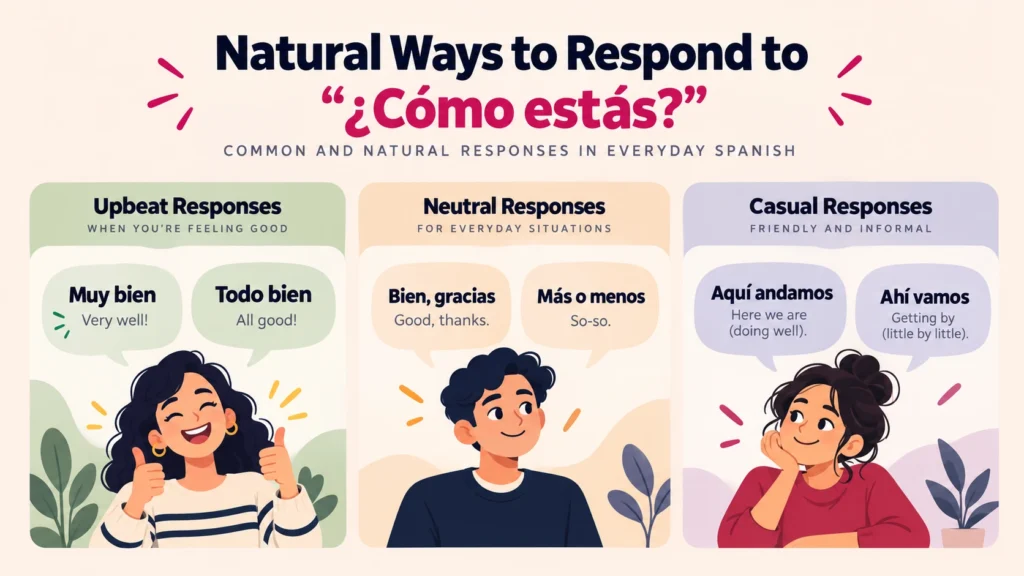
11 Natural Ways to Respond to “Cómo Estás”
Here’s the quick version before we get into the details-
| No. | Natural response | Meaning | Best use |
| 1 | Bien, gracias. ¿Y tú? | Good, thanks. And you? | Safe and neutral |
| 2 | Muy bien. | Very well. | Positive |
| 3 | Todo bien. | All good. | Casual and common |
| 4 | Bastante bien. | Pretty good. | Positive but measured |
| 5 | Genial. | Great. | Upbeat and informal |
| 6 | No me puedo quejar. | I can’t complain. | Relaxed, conversational |
| 7 | Ahí vamos. | Getting by. | Neutral or slightly tired |
| 8 | Más o menos. | So-so. | Not good, not bad |
| 9 | He estado mejor. | I’ve been better. | Honest and negative |
| 10 | Estoy cansado/a, pero bien. | I’m tired, but fine. | Honest with context |
| 11 | Todo tranquilo. | Everything’s calm / All good. | Casual |
Let’s have a look at the examples with meaning-
- Bien, gracias. ¿Y tú?
This is the one to remember if you’re just starting. Bien, gracias. ¿Y tú? It means “Good, thanks. And you?” It’s friendly and natural, and it works in most everyday situations.
- Muy bien
Feeling good? Keep it simple. Muy bien. Todo va genial. It means “very well” and gives a more positive answer than simply “bien”. Add ¿Y tú? If you want to return the question.
- Todo bien
It is one of those handy phrases you’ll hear often. Todo bien. ¿Y tú? That means “all good” and sounds relaxed rather than rehearsed.
- Bastante bien
Maybe you’re doing well, but you don’t want to make it sound like everything is perfect. Bastante bien, gracias. It means “quite well”. It’s positive without sounding overly enthusiastic.
- Genial
Want something more upbeat? ¡Genial! Acabo de terminar mi examen. Genial means “Great” or “Awesome.” It’s especially natural in friendly, informal conversations.
- No me puedo quejar
This works when things are going okay, and you don’t have much to complain about. No me puedo quejar. ¿Y tú? In natural English, it’s close to “Can’t complain”. It’s relaxed and conversational.
- Ahí vamos
Not having the best day? Ahí vamos can express that you’re getting through it. Ahí vamos. Ha sido una semana larga. Depending on the context, it can mean “I’m getting by” or “I’m hanging in there”.
- Más o menos
If you’re somewhere in the middle, más o menos is an easy option. Más o menos. Estoy un poco cansado.
It means “So-so” or “More or less”. It’s honest without forcing you into a long explanation.
- He estado mejor
When you’re definitely not having your best day. He estado mejor. Ha sido un día difícil. It means “I’ve been better”. It’s more direct than más o menos, but it still leaves room for the other person to ask what happened.
- Estoy cansado/a, pero bien
Sometimes you’re fine but just tired. Estoy cansado, pero bien. Necesito dormir. If you’re female, you’d normally say cansada. This response provides some context without turning a simple greeting into a serious conversation.
- Todo tranquilo
It is another casual option. Todo tranquilo por aquí. ¿Y tú? Depending on the context, it can mean “Everything’s calm” or “Things are quiet”. It’s useful when nothing is particularly exciting or stressful.
Positive and Upbeat Responses
When you’re genuinely having a good day, you don’t need to overthink it. Try-
- Muy bien – Very well
- Genial – Great / Awesome
- Todo bien – All good
- Bastante bien – Pretty good
- Bien, gracias. ¿Y tú? – Good, thanks. And you?
The main difference is the feeling behind each one. “Muy bien” is straightforwardly positive. “Genial” is more enthusiastic. “Bastante bien” is positive but slightly more restrained.
Neutral and Honest Responses
You also don’t have to pretend everything is great. If you’re somewhere in the middle, use-
- No me puedo quejar – I can’t complain.
- Ahí vamos – Getting by / Hanging in there.
- Más o menos – So-so.
- He estado mejor – I’ve been better.
These responses give you more room to sound like a real person rather than someone answering from a language textbook.
How to Reply to “Hola, ¿Cómo Estás?”
If someone says “Hola, ¿cómo estás?”, you can respond just as you would to ¿Cómo estás? The hola simply adds the greeting. For example-
- Bien, gracias. ¿Y tú? – Good, thanks. And you?
- Todo bien. ¿Y tú? – All good. And you?
You can also make it a little more conversational by saying “Muy bien. ¿Qué tal tú?” It means “Very well, How about you?” The important thing is that you don’t need a special reply just because hola comes first. The greeting and the question are simply doing two different jobs.
How to Answer “Cómo Está” in a Formal Situation
Here’s where tú and usted matter. For example- ¿Cómo está? Muy bien, gracias. ¿Y usted? Use this with someone in a formal setting or someone you don’t normally address with tú. The response changes slightly because you’re returning the question with ¿Y usted?, not ¿Y tú? You don’t need to make the rest of your answer complicated. Bien, gracias. ¿Y usted? It is perfectly appropriate.
How to Respond to “Cómo Estai”
Sometimes, you may come across “¿Cómo estai?” in informal Chilean Spanish. It’s a regional form associated with Chilean speech, rather than the standard form you’ll want to use everywhere.
If someone says ¿Cómo está? You can respond naturally with something like “Bien, ¿y tú?” or “Todo bien. ¿Y tú?” If you’re learning general Spanish, don’t worry about regional variation. It’s more useful to recognize forms like estai when you encounter them. And keep in mind that Spanish changes from country to country.
How to Reply When Someone Says “Estoy Bien”
This is slightly different. Suppose someone tells you Estoy bien. They’re saying, “I’m fine” or “I’m doing well.” You don’t need to answer bien again. Instead, acknowledge what they said and keep the conversation going-
- Me alegro – I’m glad
- Qué bueno – That’s good
- Genial – Great
- Me alegra saberlo – I’m glad to hear it
That’s a much more natural conversational rhythm than simply repeating the same phrase.
How Do Mexicans Say “Take Care”?
There isn’t just one Mexican way to say “take care”. The best choice depends on the situation. “Cuídate” is a common and natural option. It literally means “take care of yourself.” Try to end with “Bueno, nos vemos. “¡Cuídate!” or “Que estés bien.” It means Take care or Hope you’re well. Cuídese uses the formal usted form.
If you’re trying to sound natural in Mexico, listen to people around you use these expressions. Regional Spanish is full of small surprises. Copying the rhythm and phrases is often more useful than memorizing a list.
How to Make Your Reply Sound More Natural
It’s not about knowing the longest answer. It’s about knowing what to say after. A short reply works better when you give the other person something to hold on to. Instead of just Bien, try Bien, gracias. ¿Y tú? That little question keeps things moving.
You don’t have to say Estoy bien every time, either. Mix it up. “Todo bien”. “Muy bien”. “Bastante bien”. If a friend asks how you are, just say “Todo bien. ¿Qué tal tú?” Simple. If you’re having a rough day, say so. Más o menos. Ahí vamos. That sounds more real.
Throw in a little context, too. Don’t just stop at Bien. “Estoy cansado, pero bien” – I’m tired, but fine. One extra detail changes the whole feel. Match your reply to who you’re talking to. For a friend, “¡Genial! ¿Y tú?” works. Boss or stranger? “Muy bien, gracias. ¿Y usted?” fits better. Just to pick something that fits the person and the situation, consult with a professional instructor at Art of Language Institute.
Common Mistakes to Avoid
When replying to ¿Cómo estás?, a few small mistakes can make your Spanish sound less natural. Let’s know what to avoid-
- Thinking “Estoy bien” is the only correct answer. But native speakers use plenty of other responses. You can say “Todo bien”, “Muy bien” or “Bastante bien”.
- Using “¿Y tú?” in every situation. It’s natural with friends, but in a formal situation, “¿Y usted?” is more appropriate. Pay attention to who you’re talking to before choosing between tú and usted.
- Forcing yourself to sound positive. Spanish has plenty of natural middle-ground replies. “Más o menos” or “Ahí vamos” works. Try to be honest without making the conversation overly serious.
- Giving too much information when a short reply is enough. “¿Cómo estás?” is often used for making conversation. Simple, “Bien, gracias. ¿Y tú?” It means Good, thanks. And you? is all you need.
- Trying too hard to sound “native.” You don’t need to fill every response with slang or complicated expressions. Understand the situation and then choose a comfortable response.
Final Thoughts
You really don’t need 50 different ways to answer “¿Cómo estás?” Just pick a few that feel right. Bien, gracias. Todo bien. Muy bien. Más o menos. That’s enough to start.
Then, add a couple more conversational ones when you’re ready. “No me puedo quejar”. “Ahí vamos”. Once you know what each one means in real life, you’ll stop reaching for the same textbook answers. To practice these responses in real situations, book a spanish class through Art of Language Institute right now.
Frequently Asked Questions
Is “Cómo Estás” Formal or Informal?
¿Cómo estás? is informal and uses tú. The formal equivalent is generally used with usted.
Can I Answer “Cómo Estás” With “Todo Bien”?
Yes. Todo bien is a natural, casual way to say “All good.”
What Is the Difference Between “Estoy Bien” and “Soy Bien”?
Estoy bien means “I’m fine” or “I’m doing well”. Soy bien isn’t the normal way to express this idea, as ser and estar are used differently in Spanish.
Do I Need to Say “Gracias” Every Time I Answer “Cómo Estás”?
No. Bien, gracias is polite and common, but you can also say bien, todo bien, muy bien, or another natural response.
Why Do Some People Answer “Cómo Estás” Without Using “Estoy”?
Because the context makes the meaning clear, saying bien or todo bien is enough for the listener to understand that you’re talking about how you are.
What Should I Say If I Do Not Want to Explain How I Feel?
Use a short response such as bien, todo bien, or no me puedo quejar. You don’t have to give a detailed explanation.
Can I Reply With “¿Qué Tal?” Instead of Answering Directly?
Yes, use ¿Qué tal? as a conversational follow-up, but it’s another question rather than a direct answer. For a simple response, use bien, todo bien, or a similar phrase.
How Can I Remember Several Replies Without Mixing Them Up?
Start with “bien”, “gracias”, “muy bien”, and “todo bien”. Use them in real conversations until they become automatic, then add more.

